
A product roadmap can look perfectly achievable on paper and still fail during execution. Initiatives are prioritized, target release dates are assigned, and executive stakeholders align—only for delivery teams to later uncover hidden application dependencies, unexpected capacity limits, unmapped technical constraints, or vague task ownership.
Without a structured method for turning strategic vision into tactical execution, even well-prioritized roadmaps can become lists of ambitious goals rather than executable delivery plans. The gap usually appears when teams encounter technical debt, application dependencies, capacity constraints, or unclear ownership after commitments have already been made.
Roadmap activity planning helps bridge this gap by connecting high-level strategic priorities with the concrete activities, technical dependencies, available capacity, accountable owners, and realistic timelines required to execute them.
What You’ll Learn
By the end of this guide, you will understand how to:
- Distinguish between high-level roadmap planning, operational activity planning, and project management
- Apply a structured 7-stage framework to deconstruct initiatives into actionable work
- Define clear, measurable completion criteria for individual roadmap activities
- Account for complex technology dependencies, application portfolios, and enterprise constraints
- Use a practical roadmap activity planning template to structure execution
- Measure delivery performance using key execution metrics
What Is Roadmap Activity Planning?
Roadmap activity planning is the process of breaking high-level product roadmap initiatives down into smaller, actionable activities and organizing them by priority, effort, dependencies, ownership, and timing.
It sits directly between strategic roadmap planning and daily task or sprint management. While strategic roadmaps define directional goals, activity planning provides enough operational detail to verify whether an initiative is technically and operationally feasible before hard launch dates are promised to customers or executives.
For example, a roadmap card stating “Launch a self-service enterprise onboarding experience” is a strategic outcome, not an activity. Bringing that outcome to life requires user research, workflow design, technical discovery, API integrations, security reviews, automated testing, and go-to-market enablement.
Roadmap Planning vs. Roadmap Activity Planning
Misaligning strategic planning with daily task tracking creates operational friction. To maintain alignment, teams must understand where activity planning fits within the execution lifecycle:
| Planning Level | Primary Question | Core Focus | Key Deliverable |
| Product Strategy | Where should we compete and why? | Target market, business goals, value proposition | Strategic vision & KPIs |
| Roadmap Planning | What major initiatives should we pursue? | Sequencing strategic outcomes over time | High-level product roadmap |
| Roadmap Activity Planning | What operational work is required to deliver them? | Deconstruction, capacity, dependencies, DRIs | Feasible activity plan & timeline |
| Project & Sprint Tracking | What specific tasks need to happen next? | Daily execution, bug fixes, sprint backlogs | Sprint board & task status |
What Makes a Roadmap Activity Actionable?
To keep activity plans executable, work units must be defined clearly. A well-defined, actionable roadmap activity should feature:
- A Measurable Outcome: Explicit completion criteria rather than vague intent.
- An Accountable Owner: A designated Directly Responsible Individual (DRI).
- Estimated Effort: Realistic scope matched against actual team capacity.
- Known Dependencies: Explicit mapping of cross-team, vendor, or application prerequisites.
- Target Timing: Alignment with a specific sprint, milestone, or delivery window.
The 7-Stage Roadmap Activity Planning Process
A repeatable, structured process helps teams identify technical debt, expose dependencies, and avoid committing to unrealistic delivery schedules.
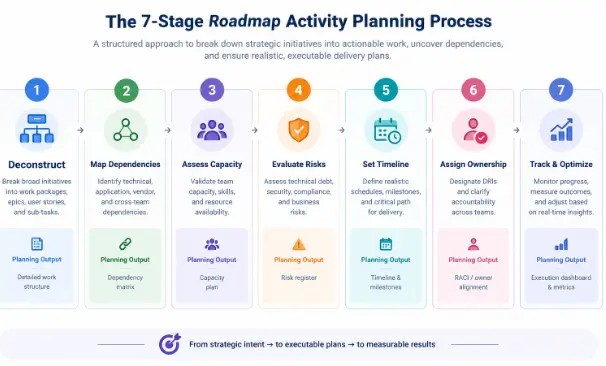
| Stage | Focus Area | Core Action | Planning Output |
| 1. Deconstruct | Activity Definition | Break broad initiatives into work packages, epics, user stories, and sub-tasks. | Structured activity backlog |
| 2. Prioritize | Value & Urgency | Rank work objectively using business impact, risk, and cost of delay. | Prioritized execution queue |
| 3. Estimate | Effort & Capacity | Gauge complexity, duration, and required skills against available capacity. | Feasible capacity model |
| 4. Map | Dependencies | Identify critical technical, cross-team, vendor, and sequential blockers. | Dependency-aware execution path |
| 5. Schedule | Timing | Sequence work against sprints, delivery milestones, or release quarters. | Realistic delivery timeline |
| 6. Assign | Ownership | Designate an accountable owner for every core deliverable. | Clear accountability |
| 7. Monitor | Progress & Change | Track velocity, cycle times, and blockers; adapt scope as requirements evolve. | Current activity plan |
1. Deconstruct Roadmap Initiatives
Deconstruct high-level themes into manageable units of work using a standard decomposition hierarchy:
Strategic Goal → Initiative → Epic → User Story → Task
- Actionable Tip: Match breakdown depth to your planning horizon. Near-term initiatives require task-level precision, while work two quarters out can remain at the epic level until discovery begins.
2. Prioritize Activities
Balance customer impact against technical effort. Teams can use prioritization frameworks such as RICE to evaluate competing activities consistently:
RICE Score = Reach × Impact × Confidence
Effort
Alternatively, Weighted Shortest Job First (WSJF) balances the Cost of Delay against total job size. The objective is not mathematical perfection, but creating a consistent framework that makes trade-offs transparent across engineering and leadership.
3. Estimate Effort and Capacity
Estimate scope using story points, T-shirt sizing, or time-based models. When calculating bandwidth, deduct non-project overhead—maintenance, bug fixes, operational support, holidays, and meetings. Assuming 100% team capacity for new feature development routinely results in unrealistic estimates and missed deadlines.
4. Identify Dependencies and the Critical Path
Unmapped blockers derail schedules. Use the Critical Path Method (CPM) to identify the longest sequence of dependent activities that determines the shortest possible delivery timeframe. Activities on the critical path deserve particular attention because a delay in one can directly affect the overall delivery date.
5. Build the Execution Schedule
Slot work into a dynamic schedule based on sprints, release quarters, or continuous delivery pipelines. Treat early dates as flexible targets until technical discovery validates your assumptions.
6. Establish Ownership
Assign every core deliverable to a single Directly Responsible Individual (DRI). When an activity is assigned to an entire “team” rather than an accountable owner, accountability dissolves and execution stalls.
7. Monitor and Adjust
Track delivery health using velocity, cycle time, and blocked-work trends. When underlying assumptions, market demands, or capacity constraints change, adapt the activity plan to reflect operational reality.
Practical Example: Deconstructing an Initiative

A repeatable, structured process helps teams identify technical debt, expose dependencies, and avoid committing to unrealistic delivery schedules.
When a strategic roadmap features the initiative “Launch Self-Service Enterprise Onboarding,” activity planning expands that card into a fully sequenced operational stream:
Mapping work this way reveals critical sequencing requirements—such as identifying when security requirements and compliance reviews must be completed before the API can move into production.
Roadmap Activity Planning Template
A roadmap activity planning template should make it easy to connect each activity to its owner, dependency, effort, priority, timing, completion criteria, and execution status:
| Initiative | Activity | DRI | Dependency | Effort | Priority | Target | Completion Criteria | Status |
| Enterprise Onboarding | Define SSO UX Workflows | Product | Customer Discovery | Medium | High | Q1 – Sprint 1 | Approved Figma prototype | Completed |
| Enterprise Onboarding | Build SAML 2.0 Auth APIs | Engineering | Architecture Sign-off | Large | High | Q1 – Sprint 2 | API passes integration tests | In Progress |
| Enterprise Onboarding | SOC 2 Compliance Review | Security | API Draft Completion | Medium | High | Q1 – Sprint 3 | SecOps sign-off documented | Blocked |
| Enterprise Onboarding | Publish API Documentation | Tech Writing | API Finalization | Small | Medium | Q1 – Sprint 4 | Docs live on developer portal | Planned |
Roadmap Activity Planning vs. Project Management
Many teams confuse activity planning with project management. While both deal with execution, they serve distinct operational functions:
| Dimension | Roadmap Activity Planning | Project Management |
| Primary Goal | Connects strategy to execution feasibility | Manages execution of defined project scope |
| Scope Focus | Strategic roadmap initiatives and outcomes | Discrete project deliverables and tasks |
| Dependency Horizon | Identifies technical & portfolio blockers before commitment | Tracks task dependencies during execution |
| Optimization Focus | Balances value, capacity, and release timing | Manages scope, schedule, budget, and resources |
| Key Question | “Can this work realistically be delivered on this timeline?” | “How do we track the daily work to hit our committed date?” |
Managing Technology Dependencies in Enterprise Roadmaps
In complex enterprise environments, a roadmap initiative can appear viable from a product perspective while being constrained by the technology landscape underneath it. Roadmaps rarely exist in isolation—they intersect with enterprise architecture, application portfolios, legacy systems, technology lifecycles, infrastructure, vendors, and cross-departmental governance workflows.
An initiative may depend on an application scheduled for retirement, an API migration, infrastructure provisioning, a vendor contract, a security review, or another team’s platform release—dependencies that may not appear on the product roadmap itself. These dependencies can remain invisible when product roadmaps are managed separately from enterprise technology portfolios. As a result, an initiative may appear ready for development even though a critical application, platform, vendor, or infrastructure dependency has not been addressed.
Activity planning must explicitly account for these technology realities, including:
- Application Portfolio Management Dependencies: Ensuring new features integrate smoothly with core ERP, CRM, or legacy databases without creating technical bottlenecks.
- Enterprise Architecture Management Reviews: Scheduling necessary architectural governance board approvals and cloud infrastructure provisioning before engineering sprints start.
- Technology Lifecycle Management Constraints: Factoring in planned platform upgrades, software deprecations, or vendor license renewals that could disrupt delivery windows.
- Security & Compliance Approvals: Building explicit buffer time for SOC 2, GDPR, or internal cybersecurity audits before deploying code to production.
Addressing technology dependencies early prevents strategic roadmap commitments from crashing into operational hurdles.
How to Measure Roadmap Execution
Evaluating execution based solely on output volume can be misleading. Completing fifty minor tasks offers little value if strategic priorities stall. Track execution health using these core metrics:
- Delivery Predictability: The percentage of planned activities delivered within estimated timeframes.
- Planned vs. Actual Effort: The variance between estimated and actual effort across activities, helping teams continuously improve future capacity planning.
- Blocked-Work Rate: The frequency and duration of tasks stalled by unmapped dependencies.
- Dependency Resolution Time: The average time required to identify and resolve a dependency that is blocking a roadmap activity.
- Cycle Time: The total time elapsed from when work begins on an activity to its final production release.
- Capacity Utilization: The percentage of available team capacity committed to planned roadmap work after accounting for operational support, maintenance, technical debt, and other non-roadmap work.
Roadmap Activity Planning Best Practices
- Detail Near-Term Work First: Maintain granular task detail for upcoming sprints, but keep long-term initiatives at a higher epic level until discovery begins.
- Reserve Operational Capacity: Never plan teams at 100% utilization. Allocate explicit bandwidth for maintenance, technical debt, and unplanned support issues.
- Validate Dependencies Before Committing: Never promise fixed delivery dates to external customers until cross-team, security, and infrastructure dependencies are verified.
- Maintain Flexibility: Treat your activity plan as an adaptable baseline. When priorities pivot, use your activity plan to quantify the exact cost and trade-offs of changing scope.
Common Roadmap Activity Planning Mistakes
- Planning Distant Work at Task Level: Over-planning activities twelve months in advance leads to wasted effort when market assumptions inevitably shift.
- Ignoring Operational Load: Omitting technical debt, maintenance, and regular meetings leads to unrealistic schedules and team burnout.
- Undocumented Dependencies: Failing to map cross-team or system prerequisites early causes sudden blockers near release dates.
- Shared Task Ownership: Assigning deliverables to whole “teams” instead of individual DRIs leads to diffuse accountability and missed deadlines.
- Treating Roadmaps as Fixed Contracts: Forcing rigid compliance with outdated plans causes teams to release low-quality software rather than adapting to new information.
Turning Strategy Into Executable Roadmaps
For enterprise organizations, roadmap execution extends beyond product and project task management. Strategic initiatives are often connected to application portfolios, technology lifecycles, infrastructure, vendors, and enterprise architecture.
When those relationships aren’t visible, teams can make roadmap commitments without understanding the technology constraints that may affect delivery.
PεMVISH provides connected visibility across technology portfolios, helping enterprise architects, IT leaders, and product teams understand how strategic initiatives relate to applications, technology, dependencies, and lifecycle considerations. The key is not replacing existing roadmap or project-management tools, but providing the technology context needed to make roadmap decisions more informed and executable.
Frequently Asked Questions
1. What is roadmap activity planning?
Roadmap activity planning is the process of breaking high-level strategic roadmap initiatives into actionable units of work, then organizing them by priority, dependencies, ownership, effort, and execution timelines.
2. How does roadmap activity planning differ from roadmap planning?
Roadmap planning defines what strategic initiatives a product will pursue and roughly when. Roadmap activity planning determines how those initiatives will be operationally delivered by breaking them into manageable tasks, mapping dependencies, and assigning accountable owners.
3. How far in advance should roadmap activities be planned?
Near-term roadmap activities should generally be planned in greater detail because requirements, dependencies, capacity, and ownership are better understood. Longer-term initiatives can remain at the epic or milestone level until discovery provides enough information to define detailed activities. This approach reduces wasted planning effort while keeping the roadmap adaptable.
4. How do you break a product roadmap into actionable activities?
Start with the strategic goal, then decompose the initiative into phases, epics, user stories, and sub-tasks. Identify the technical and cross-team dependencies for each unit of work, estimate required effort against available capacity, and assign a single Directly Responsible Individual (DRI).
5. What should a roadmap activity planning template include?
A roadmap activity planning template should typically include the initiative, activity, accountable owner, dependencies, priority, estimated effort, target timeframe, completion criteria, and execution status. For enterprise initiatives, it can also track affected applications and technology risk indicators.
6. Why are technology dependencies important in roadmap activity planning?
Technology dependencies—such as legacy application constraints, API availability, security compliance reviews, and infrastructure provisioning—dictate whether an initiative is technically feasible and can be delivered on schedule. Unmapped dependencies are a leading cause of delivery delays in enterprise roadmaps.


